SonotaCo.JP
SonotaCo Network Japan Forum
|
 |
|
|
| 前のトピックを表示 :: 次のトピックを表示 |
| 投稿者 |
メッセージ |
Bill W
登録日: 2012.02.13
記事: 194
所在地: Glasgow
|
 日時: Thu Jul 30, 2015 7:09 pm 記事の件名: 日時: Thu Jul 30, 2015 7:09 pm 記事の件名: |
 |
|
Hi Koji,
That is fantastic! You even have it in the second order!!!
What was the iso setting used?
I had a look at the sony camera but it was very expensive in the UK market.
It is nice to see a "real" colour spectrum. You have good detail all the way down to the deep blue end.
The classification of meteor spectra is very difficult because we have much better instruments that before. The old photographic scheme in the IMO photographic handbook only had four very broad groups.
With the equipment and software we now have I believe we can start to make new discoveries about the meteoroid sources. If we start to see detailed similarities amongst a large sample then we will be on the right track!
Best regards,
Bill.
|
|
| トップに戻る |
|
 |
Bill W
登録日: 2012.02.13
記事: 194
所在地: Glasgow
|
|
| トップに戻る |
|
|
Bill W
登録日: 2012.02.13
記事: 194
所在地: Glasgow
|
| 日時: Thu Jul 30, 2015 8:42 pm 記事の件名: |
|
|
Hi Martin,
I think it would be an interesting experiment/comparison if you could use your method on Koji's image just to see how close the wavelenghts are to each other.
cheers,
Bill.
|
|
| トップに戻る |
|
|
Martin Dubs
登録日: 2014.03.04
記事: 56
|
| 日時: Fri Jul 31, 2015 5:05 am 記事の件名: |
|
|
Hi Bill and Koji,
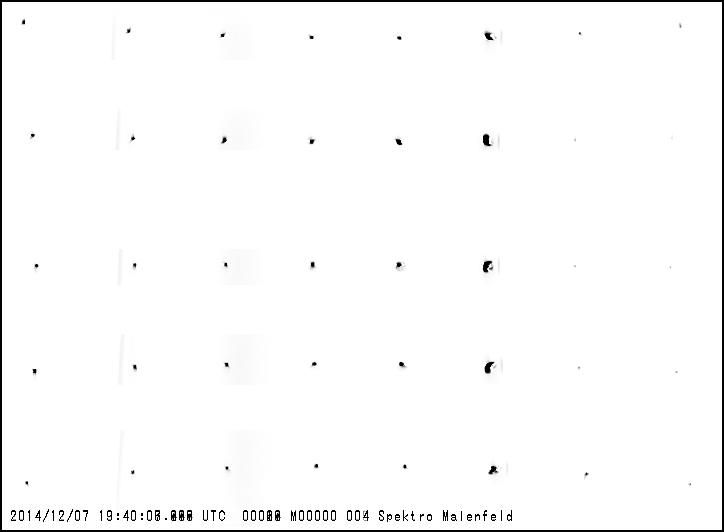
this is an interesting idea. My analysis method is not limited to video and without having any meteor spectra of my own with a high resolution camera I would be interested to apply the analysis to Koji's spectra. However I need some additional data for the calibration. As shown on page 13 of my report for Aspect 2015 http://www.meteorastronomie.ch/images/MeteorSpectroscopy_Aspekt2015_part2.pdf
I did calibrate the lens distortion with a series of spectra of a He-Ne laser. The minimum is three spectra, one running at the top, one in the center of the image and one at the bottom of the image, showing at least 4 different orders (see below). Even better is the use of a blue laser (405 nm), but also a neon glow discharge lamp will do perfectly, the latter having more lines to calibrate with, improving the fit of the polynomial describing the required transformation and the determination of the image center (x0, y0). So I may ask Koji to make some of these calibration images and send them to me together with the spectrum. I would try to analyze them. Once the calibration is determined, analysis of further spectra is very easy, as long as the setup and orientation of the grating is not changed (the grating should be mounted perpendicular to the optical axis in the first place).
It would be very nice to have an example of the method with a high resolution image. In M20150729 the curvature of the spectra from lights is well visible. With my transformation this should be straightened as well. Too bad the lamps are not low pressure sodium or mercury lamps, these could be used for calibration as well.
(One advantage of the color camera: The identification of the orders is very simple, less overlap because of the limited spectral range).
Would be nice if we could do some collaboration together. At the moment I am still in the test phase, but a paper has been submitted to the journal of IMO. As soon as this is accepted I will be more active in promoting my type of meteor spectral calibration.
Best regards, Martin
| 説明: |
|
| ファイルサイズ: |
14.92 KB |
| 閲覧数: |
35486 回 |
|
|
|
| トップに戻る |
|
|
前田
登録日: 2004.09.01
記事: 2968
所在地: Miyazai JAPAN (E131.4, N31.8)
|
| 日時: Fri Jul 31, 2015 7:21 am 記事の件名: responce |
|
|
Hi Bill,
Thank you for make figure of spectrum. I can make it, but it will take a time about half of hour. I have a lot of low resolution meteor spectra using by SD camera. I do not have a time to analyze these spectra, now.
Hi, Martin,
Thank you for your comments. I may be make a calibration data. But there is a prblem. My grating is not fixed aganst a sensor. This put on the lens by an adhesive tape, then the angle of grating is easy to rotate day by day by a focusing.
Best regards, Koji
|
|
| トップに戻る |
|
|
Martin Dubs
登録日: 2014.03.04
記事: 56
|
| 日時: Fri Jul 31, 2015 3:40 pm 記事の件名: |
|
|
Hi Koji,
as long as the grating is perpendicular to the optical axis (which should be the case if you put it on the front of the lens) a rotation around this axis does not prevent the calibration. I can rotate it to the correct orientation by software if not too far off. If you can give it a try I would be very pleased.
Martin
PS: I found an ad for a new camera perfectly suited for meteor spectroscopy, only the price is a little drawback:
http://www.engadget.com/2015/07/30/canon-me20f-sh/ 
|
|
| トップに戻る |
|
|
Bill W
登録日: 2012.02.13
記事: 194
所在地: Glasgow
|
| 日時: Fri Jul 31, 2015 8:29 pm 記事の件名: |
|
|
Wow, what a cracking camera. 4 million iso, its getting crazy!
Why are all the good toys so expensive....
Maybe it will come down in price after release, we can only hope.
It is really interesting to see the move away from tiny pixels after years of camera manufacturers making models with ever smaller pixels.
As my fellow countryman "Scotty" would say, "Ye cannae change the laws of physics, captain..." 
|
|
| トップに戻る |
|
|
Bill W
登録日: 2012.02.13
記事: 194
所在地: Glasgow
|
| 日時: Sat Aug 01, 2015 12:54 am 記事の件名: |
|
|
Hi,
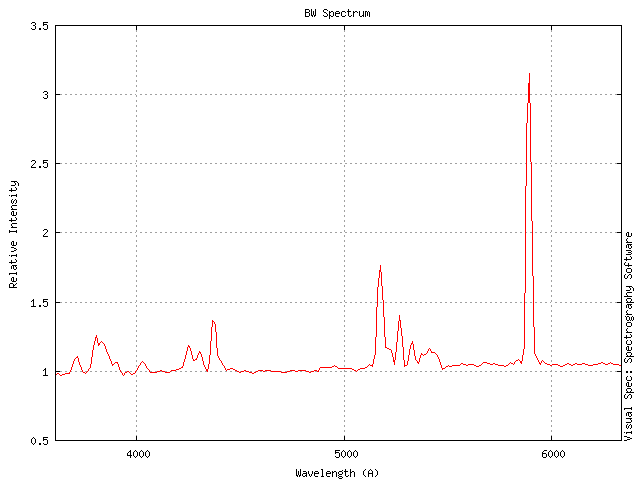
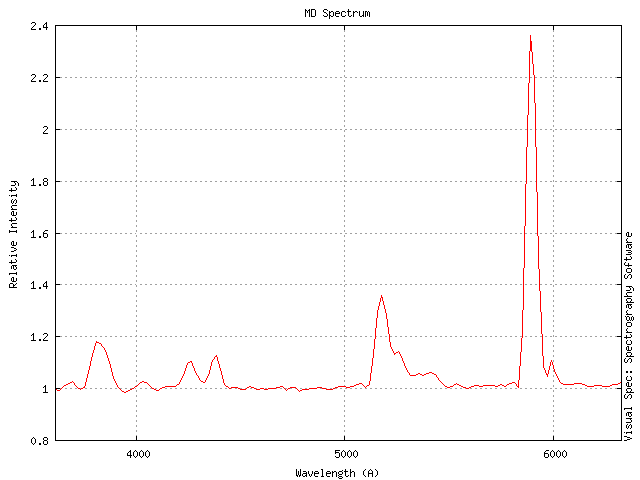
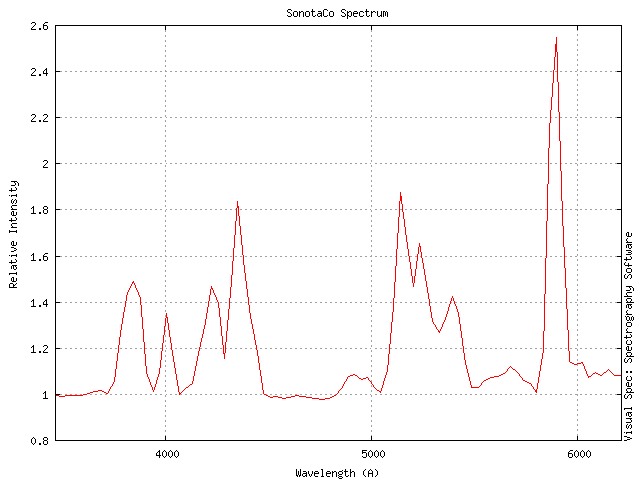
I did another quick work over of the three spectra that I mentioned might all be of the same "stuff". Like I said, I beleive when there are really similar properties I think this is pointing us in some sort of direction!
Here are mine, Martins and SonotaCos' spectrum. Even if the wavelength calibration is a bit out (especially with SonotaCo's as it was a very wide field image and small image scale) the form and similarities of the spectra are remarkable. This is the closest "grouping" of meteors, apart from shower meteors, I've seen.
Really cool....
cheers,
Bill  
| 説明: |
|
| ファイルサイズ: |
5.04 KB |
| 閲覧数: |
35435 回 |
|
| 説明: |
|
| ファイルサイズ: |
5.22 KB |
| 閲覧数: |
35435 回 |
|
| 説明: |
|
| ファイルサイズ: |
5.79 KB |
| 閲覧数: |
35435 回 |
|
|
|
| トップに戻る |
|
|
前田
登録日: 2004.09.01
記事: 2968
所在地: Miyazai JAPAN (E131.4, N31.8)
|
| 日時: Sat Aug 01, 2015 3:35 pm 記事の件名: |
|
|
Hi, Martin,
Thank you, I understand the rotation of grating is no problem. I took a calibration picture.
I ask some questions.
Need the image to capture from video?
Do the images need original resolution (ex. 4K tiff file) or compressed image ( JPEG)?
I hope to do some collaboration together, I may be able to provide you some meteor images.
Hi, Bill,
I hope to know the detals for your spectrum charts which are depend on grating, focal length of lens, image sensor size and so on. Please let me show the each parameter.
And how about my spectrum plot by your simulation?
Koji
| 説明: |
Test picture
24mm lens, 600 lines gating, SONY a7s
with green laser (532nm) pointer
compressed 25% |
|
| ファイルサイズ: |
43.25 KB |
| 閲覧数: |
35422 回 |

|
|
|
| トップに戻る |
|
|
Martin Dubs
登録日: 2014.03.04
記事: 56
|
| 日時: Sat Aug 01, 2015 5:41 pm 記事の件名: |
|
|
Hi Koji,
I am pleased to hear that you are interested in a collaboration. The picture of the green laser is what I suggested for calibration. But for analysis, I need the full resolution, the same for the spectra (individual frames or peak image for a start). This means large files. Can you send them to me by private mail, or even better, do you have a server from where I could download these? I have sent you a private mail to mae at...., so you could give me this information privately. What I also need are spectra of the green laser at the top of the image, at the center and at the bottom of the image. Further I need the paramaters of the camera, as given in the files M*.xml and M*A.xml, in particular I need the x/yratio of the pixels of an astrometrically analyzed image (without grating).
I think we should communicate in private, as this gets a bit too far for a forum and report the outcome here.
Best regards,
Martin
|
|
| トップに戻る |
|
|
前田
登録日: 2004.09.01
記事: 2968
所在地: Miyazai JAPAN (E131.4, N31.8)
|
| 日時: Sat Aug 01, 2015 11:08 pm 記事の件名: |
|
|
Hi Martin,
I found your e-mail in my dust box! I can read it. Thank you for your attention.
Now, UFOAnalyzer V2 dose not work perfectly for my 4K video file.
The parameter of camera is a provisional values... .
Ok, the detals are by e-mail.
Thank you,
Koji
|
|
| トップに戻る |
|
|
前田
登録日: 2004.09.01
記事: 2968
所在地: Miyazai JAPAN (E131.4, N31.8)
|
| 日時: Wed Aug 12, 2015 9:53 am 記事の件名: PER fireball |
|
|
Hi,
I took a Per's fireball this morning. Unfortunately, this is only still image, we can see nice details. It was a dark night, the sensitivity of camera became high. Then, the image was noisy.
Thank you,
Koji
| 説明: |
SONY a7S + Canon FD50mmF1.4 + 600 lines grating
1/5 size of 4K image
Left bottom lines are airplane
(correction on 12/08/15) |
|
| ファイルサイズ: |
17.04 KB |
| 閲覧数: |
35262 回 |

|
|
|
| トップに戻る |
|
|
Bill W
登録日: 2012.02.13
記事: 194
所在地: Glasgow
|
|
| トップに戻る |
|
|
Bill W
登録日: 2012.02.13
記事: 194
所在地: Glasgow
|
| 日時: Sat Aug 15, 2015 10:27 pm 記事の件名: |
|
|
Hi,
It's taken a few days to work through the 38gb of video.
My final counts were
2200UT-0320UT 337 Perseids, 51 Sporadics/other showers.
28 Spectra (8 Complete/good ones)
Cheers,
Bill.
|
|
| トップに戻る |
|
|
Bill W
登録日: 2012.02.13
記事: 194
所在地: Glasgow
|
| 日時: Sun Aug 16, 2015 1:39 am 記事の件名: |
|
|
Martin/Koji,
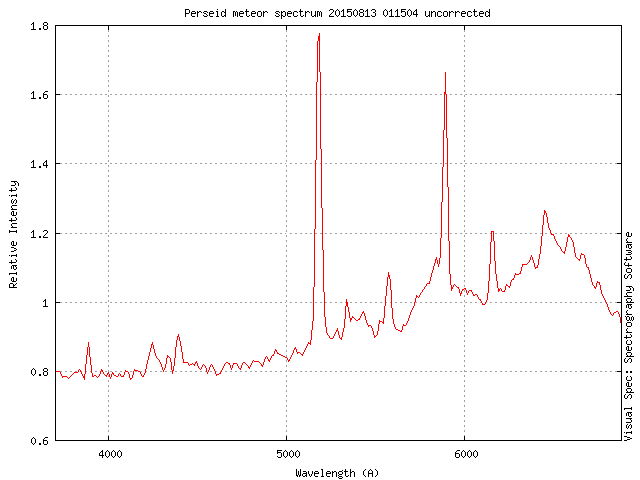
Related to the process of wavelength calibration is that of intrument response correction.
In some of the postings here I've used the technique described by Christian Buil on his IRIS pages.
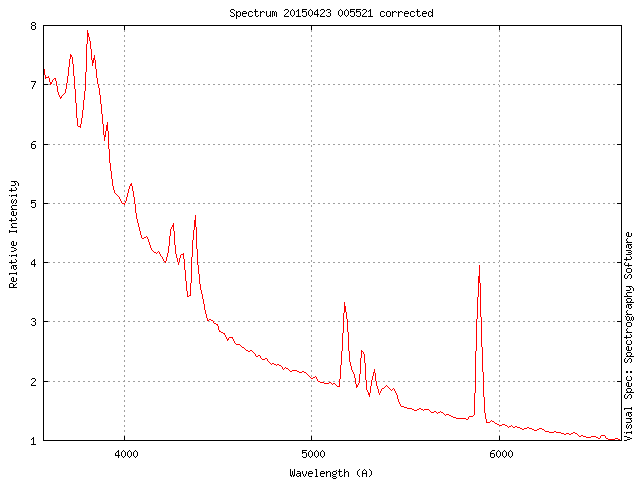
That seems to work well in some cases but not in all. Correcting for the blue end with a high temp flux doesn't correct the red end well and the reverse is equally true. A good fit to the red seriously underestimates the blue.
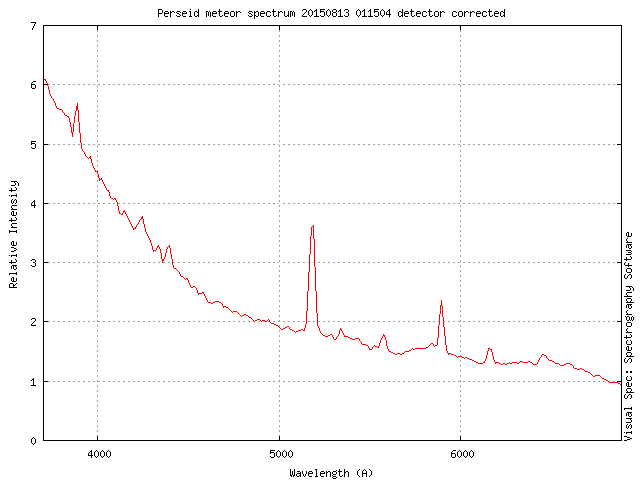
I think this is related to the intrinsic responsivity of the silicon photodiode sites in our detectors.
Downloading a nominal response curve from a large photodiode manufacturer I manually made up a .dat file to use in Visual Spec. This shows really clearly how poor the blue response is compared to the red end when using a silicon detector!
Though not perfect, (as this sensitivty curve changes as the individual phodiode sites get baised the change is minor at the blue end) I think this is a step in the right direction.
The next thing to fully understand is how to do a full flux correction so we can get w/m2/nm
Theres several papers by the experts Borovicka and Jenniskens but I'm not sure how we can convert these ideas to an easy method for us amateurs!
This might be another topic for direct emai but I'm interested to hear from anyone with ideas. I have no doubt that somebody somewhere will know how to do this!
Using the only Persied I captured this year that had any blue lines to test on I did a division by the silicon response and its quite revealing.
See attached graphs. They are all normalised around 700nm.
It occured to me that a prior posting here (the one with the iron lines) also shows the failings of using the stellar method in some cases. I've attache the re-done version of this too. It shows how badly wrong it goes in the blue in my original posting
Its quite tricky all of this .
cheers,
Bill.
| 説明: |
|
| ファイルサイズ: |
6.08 KB |
| 閲覧数: |
35176 回 |
|
| 説明: |
|
| ファイルサイズ: |
5.56 KB |
| 閲覧数: |
35176 回 |
|
| 説明: |
|
| ファイルサイズ: |
5.48 KB |
| 閲覧数: |
35176 回 |
|
|
|
| トップに戻る |
|
|
|
|
新規投稿: 不可
返信投稿: 不可
記事編集: 不可
記事削除: 不可
投票参加: 不可
このフォーラムで添付ファイルを投稿 できません
このフォーラムでファイルをダウンロード できます
|
Powered by phpBB © 2001, 2005 phpBB Group
|
 Top Page
 FAQ
FAQ 検索
検索 メンバーリスト
 ユーザーグループ
 登録する
登録する プロフィール
 プライベートメッセージをチェックする
 ログイン
ログイン


