| 前のトピックを表示 :: 次のトピックを表示 |
| 投稿者 |
メッセージ |
Martin Dubs
登録日: 2014.03.04
記事: 56
|
 日時: Sun Aug 16, 2015 7:10 pm 記事の件名: 日時: Sun Aug 16, 2015 7:10 pm 記事の件名: |
 |
|
Hi Bill,
you are correct, instrument response should be corrected. I have worked quite a bit on flux calibration for stellar spectra, so I know about all the pitfalls. It is a tricky subject, therefore I have avoided it as far as possible, although I have made some attempts.
There are several points which require careful examination. At this point I would to mention just the most important ones.
- Detector data sheeets usually give quantum efficiency versus wavelength. This is different from detector response in ADU/Joule (a factor Lambda enters in converting photons to energy)
- background has to be removed carefully when evaluating the response function. In your spectra you have a constant signal at 3800 A which probably is background because response is practically zero at those wavelengths. In my processing pipeline background is evaluated from video frames before or after the meteor event. In nthat case you frequently have division by zero, which does not make it any better.
- grating efficiency also varies over the wavelength range. It is also angle dependent, making it more complicated for wide angle lenses.
- The correct way to get the instrument response is from measuring spectra of objects with known spectral energy distribution. Unfortunately the dynamic range of the detectors makes this very difficult. With B or A type stars you have low signal in the red, with Jupiter you have methane bands, with less bright stars you have not enough signals etc.
Nevertheless the subject is worth discussing and I will follow up.
To end this on a positive note I add the analysis of Koji's beautiful spectrum, linearized in wavelength.
Best regards, Martin
| 説明: |
| spectrum transformed to orthograpic projection with linear wavelength scale |
|

ダウンロード |
| ファイル名: |
m20150729_233324_jpmz1_hep-d_trichro.jpg |
| ファイルサイズ: |
630.62 KB |
| ダウンロード回数: |
531 回 |
|
|
| トップに戻る |
|
 |
Bill W
登録日: 2012.02.13
記事: 194
所在地: Glasgow
|
| 日時: Wed Aug 19, 2015 6:05 am 記事の件名: |
|
|
Hi,
Very tricky indeed! Lots of variables to try and eliminate. I first started using the method of A0 stars as described by Christian Buil but you're right there are problems and not only at the red end. It was the difficulties at the blue end that made me start looking at other methods. Trying extract a decent contiuum to use when one needed to supress so many of the lines made it almost impossible to do well.
I think the "nominal silicon photodiode response method"  , whilst not really useful for proper radiometery gives a realistic "look" to the spectrum at least. , whilst not really useful for proper radiometery gives a realistic "look" to the spectrum at least.
I'll need to dig out the papers by the experts and study them carefully to see if I can understand them better.
A great job on Koji's spectrum, looks perfect. 
cheers,
Bill.
|
|
| トップに戻る |
|
|
Bill W
登録日: 2012.02.13
記事: 194
所在地: Glasgow
|
|
| トップに戻る |
|
|
Bill W
登録日: 2012.02.13
記事: 194
所在地: Glasgow
|
| 日時: Mon Sep 28, 2015 1:50 am 記事の件名: |
|
|
Hi,
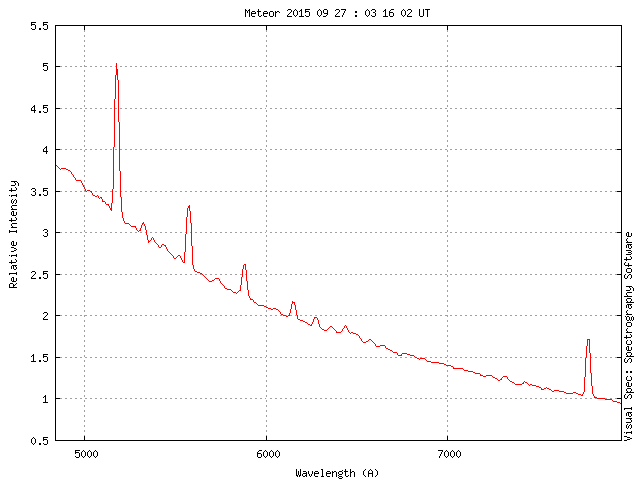
Not quite a fireball but it looks like another multi station capture. I didn't get the zero order but I'm hoping the other stations will be able to get an orbit from their observations.
Had bright emission from the forbidden Oxygen line at 557.7nm as well as oxygen at 615.7nm and ionised silicon at ~640nm. So looks like a high an fast meteor.
With the strongest emission from Magnesium I wonder if this would have appeared as a greenish meteor to the un-aided eye...?
I've done the correction using a A0 star again but with some smoothing to try and eliminate some of the previous problems with the continuum.
cheers,
Bill.
| 説明: |
|
| ファイルサイズ: |
5.42 KB |
| 閲覧数: |
34635 回 |
|
| 説明: |
|
| ファイルサイズ: |
7.33 KB |
| 閲覧数: |
34635 回 |

|
|
|
| トップに戻る |
|
|
Bill W
登録日: 2012.02.13
記事: 194
所在地: Glasgow
|
| 日時: Tue Sep 29, 2015 4:08 am 記事の件名: |
|
|
Hi,
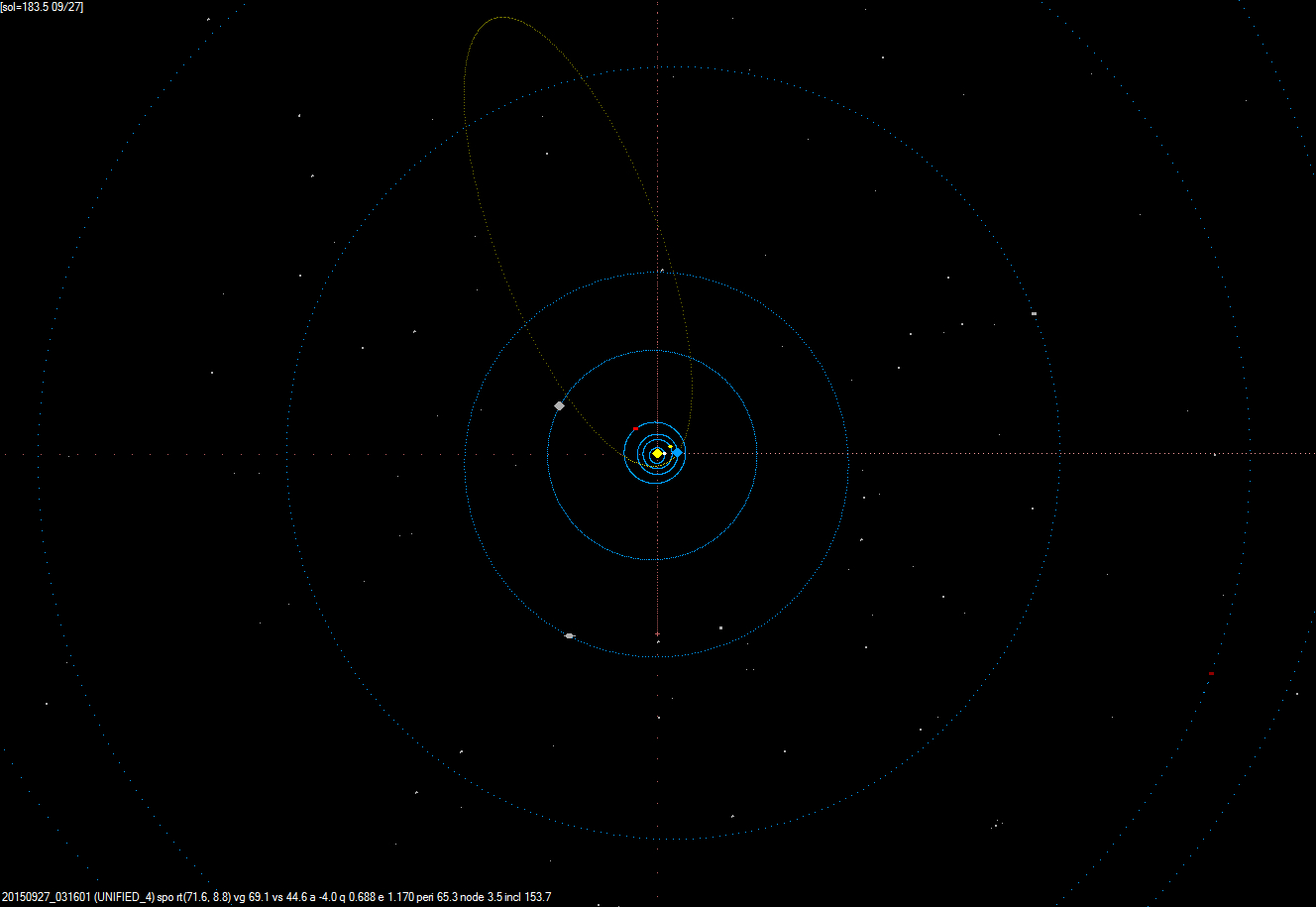
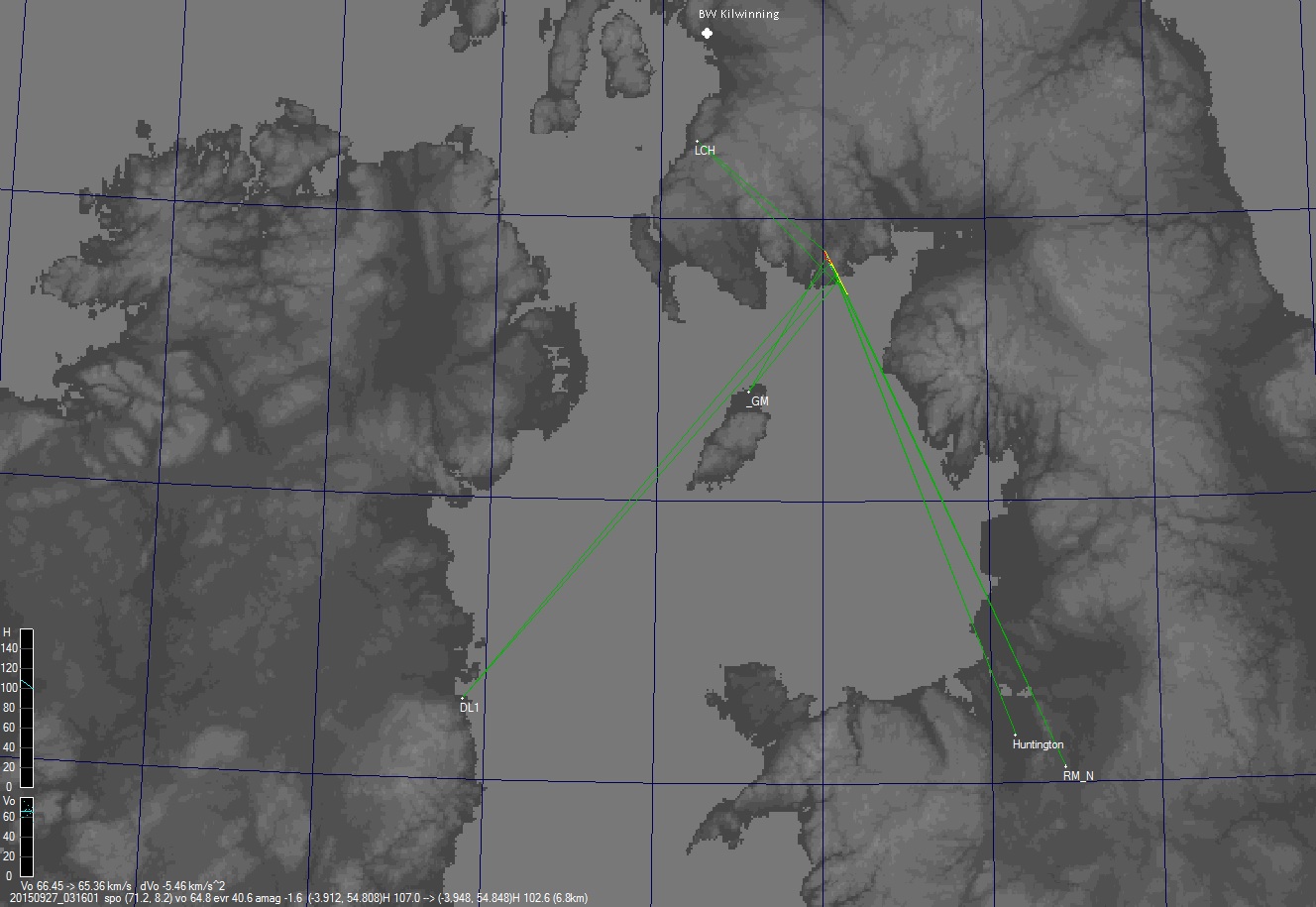
After the efforts of William S and several other captures by members ofthe NEMETODE group the orbit for this meteoroid has been determined. The meteor was very foreshortened from my position.
Retrograde and fast! As well as having a very distant aphelion, out past Uranus!
Graphics courtesy of William and Nemetode. (http://www.nemetode.org/)
Koji,
Are there any other stations in Japan doing video meteor spectroscopy?
Cheers,
Bill.
| 説明: |
|
| ファイルサイズ: |
296.38 KB |
| 閲覧数: |
34603 回 |
|
| 説明: |
|
| ファイルサイズ: |
239.53 KB |
| 閲覧数: |
34602 回 |
|
|
|
| トップに戻る |
|
|
Bill W
登録日: 2012.02.13
記事: 194
所在地: Glasgow
|
| 日時: Wed Sep 30, 2015 5:47 pm 記事の件名: |
|
|
Hi,
Due to futher analysis by William there are a few curious issues about the orbit.
The eccentricity is greater than 1 which can't exist so the orbit can only be considered provisional.
cheers,
Bill.
|
|
| トップに戻る |
|
|
前田
登録日: 2004.09.01
記事: 2969
所在地: Miyazai JAPAN (E131.4, N31.8)
|
| 日時: Thu Oct 01, 2015 1:37 am 記事の件名: |
|
|
Hi Bill
>Are there any other stations in Japan doing video meteor spectroscopy?
Yes, I know a few stations. As you know, Sonotaco observes spectrum, too.
But these are not systematic observation.
This video is one of the famous observer's one. It is wonderful.
https://www.youtube.com/watch?v=797PskigufU
Koji
|
|
| トップに戻る |
|
|
前田
登録日: 2004.09.01
記事: 2969
所在地: Miyazai JAPAN (E131.4, N31.8)
|
| 日時: Sat Oct 03, 2015 8:42 am 記事の件名: interesting spectrum |
|
|
Hi all,
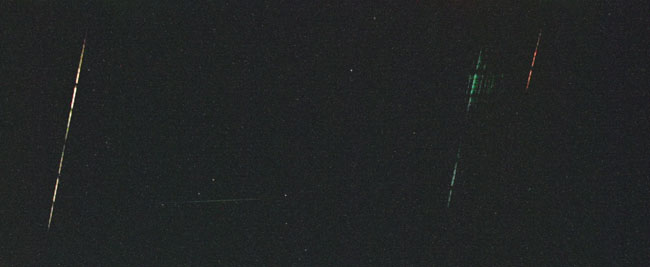
I got a slightly unusual spectrum, last night.
The early half of meteor is nornal type spectrum (Na +Mg). But last half is only Mg type spectrum. The light curve of spectrum is interesting.
The meteor was slow speed and sporadic.
Na may evaporate at the early time.
Koji
| 説明: |
triming from 4K 30p video
SONY alpha 7s + 24mm lens + 600 lines grating |
|
| ファイルサイズ: |
44 KB |
| 閲覧数: |
34555 回 |
|
|
|
| トップに戻る |
|
|
Bill W
登録日: 2012.02.13
記事: 194
所在地: Glasgow
|
| 日時: Wed Oct 14, 2015 6:31 am 記事の件名: |
|
|
Hi,
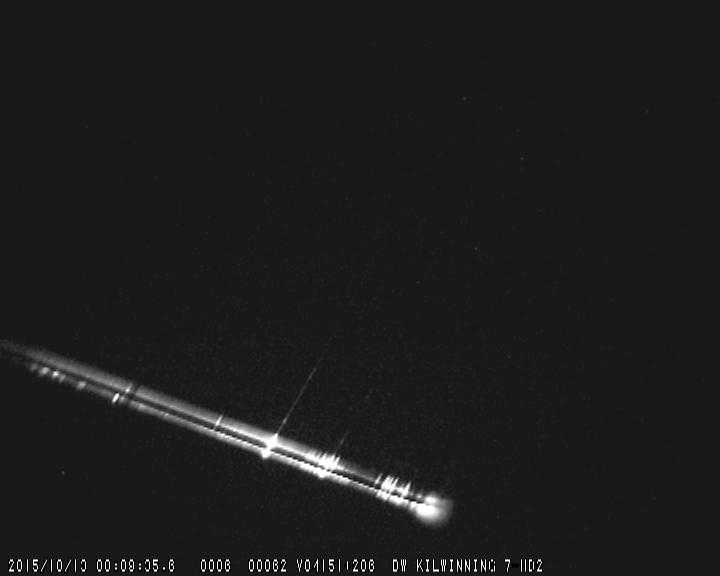
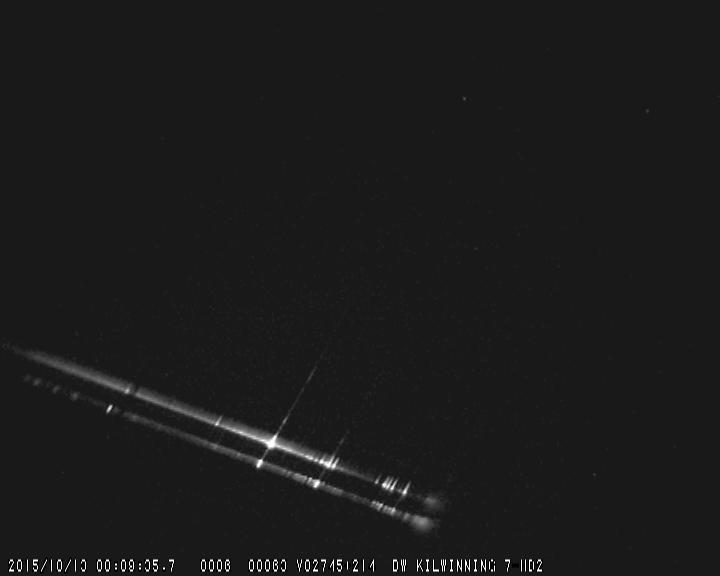
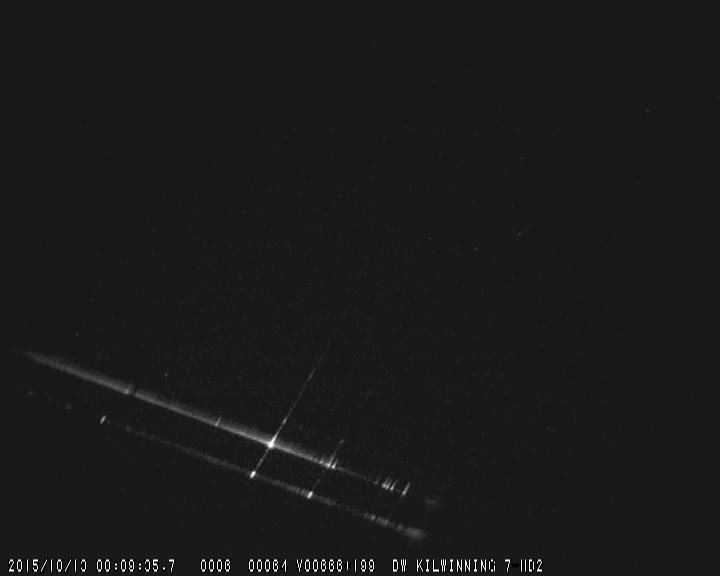
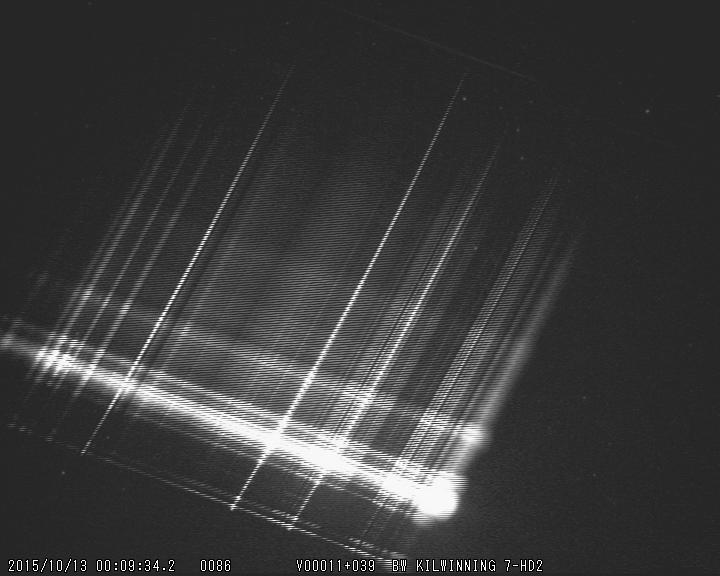
Got another interesting fireball like the very first one in the topic. When looking at the individual video frames the last few were fascinating!
The surviving fragment can be seen separating from the terminal flare with it's own but slightly different spectrum. 
Koji, this was the opposite to yours, the sodium line was the very last one to fade away.
We just never know what we're going to catch in the sky!
Video is here https://www.youtube.com/watch?v=F0dnyyQzUfs
cheers,
Bill.
| 説明: |
|
| ファイルサイズ: |
17.58 KB |
| 閲覧数: |
34467 回 |
|
| 説明: |
|
| ファイルサイズ: |
15.99 KB |
| 閲覧数: |
34467 回 |
|
| 説明: |
|
| ファイルサイズ: |
14.97 KB |
| 閲覧数: |
34467 回 |
|
| 説明: |
|
| ファイルサイズ: |
48.5 KB |
| 閲覧数: |
34467 回 |
|
|
|
| トップに戻る |
|
|
前田
登録日: 2004.09.01
記事: 2969
所在地: Miyazai JAPAN (E131.4, N31.8)
|
| 日時: Fri Oct 16, 2015 10:31 pm 記事の件名: |
|
|
Hi Bill,
This meteor and spectrum are interesting. The difference in spectrum between meteor and short duration train are very clear. These are almost the same in a usual case, I think.
Thank you for your upload.
Koji
|
|
| トップに戻る |
|
|
Bill W
登録日: 2012.02.13
記事: 194
所在地: Glasgow
|
| 日時: Fri Oct 16, 2015 11:23 pm 記事の件名: |
|
|
Hi Koji,
Thanks, this was a very interesting one indeed. These rapid variations have been described and modelled by Borovicka and Jenniskens in a lot of work done on the Leonids in 1999-2002. Most of this was done with CCD's though.
Being able to watch the changes in real time is truly fascinating!
Video spectroscopy is the only way to really see this sort of event.
I am hoping that one day WATEC will bring out a 2/3in type, mega pixel chip camera that is as sensitive as the 910, that would be a powerful observing tool. (but cheap enough for amateurs to afford!)  
The QHY is a good camera (and inexpensive) but not sensitive enough with the current driver/electronics configuration.
cheers,
Bill.
|
|
| トップに戻る |
|
|
前田
登録日: 2004.09.01
記事: 2969
所在地: Miyazai JAPAN (E131.4, N31.8)
|
| 日時: Mon Oct 19, 2015 12:27 am 記事の件名: sporadic meteor spectrum |
|
|
Hi Bill,
Yes, I hope a sensitive and HD mono color video camera, too.
The QHY cameras are not general in Japan. I have not known them till you have post.
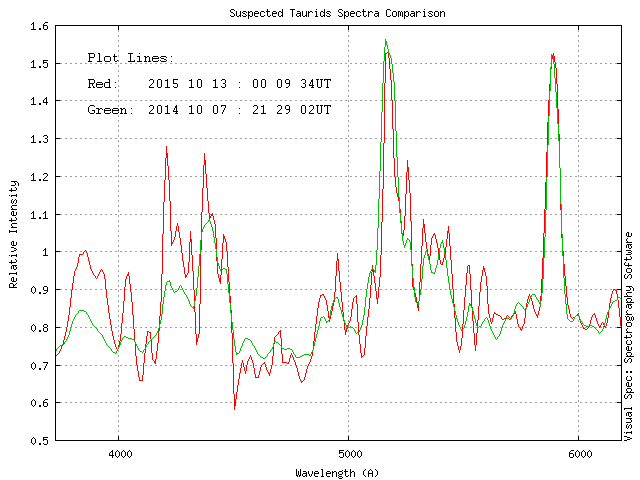
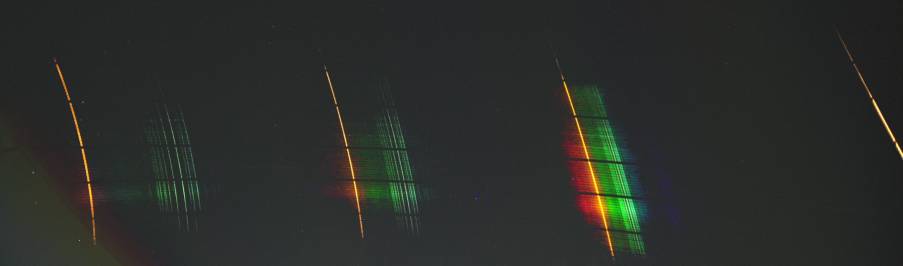
I obtained a small fireball spectrum tonight. This meteor is sporadic but near from STA radiation point. The meteor is very slow. Na and Fe lines are strong, but Mg lines are faint.
This year, Taurid shower is expected to be active. I hope to observe many Taurids spectra.
Best regards,
Koji
| 説明: |
SONY a7S + Canon FD24mmF1.4 + 600 lines grating
1/5 size of 4K image |
|
| ファイルサイズ: |
9.19 KB |
| 閲覧数: |
34403 回 |
|
|
|
| トップに戻る |
|
|
Bill W
登録日: 2012.02.13
記事: 194
所在地: Glasgow
|
|
| トップに戻る |
|
|
Jakub Koukal
登録日: 2015.10.31
記事: 3
|
| 日時: Sun Nov 01, 2015 7:27 pm 記事の件名: |
|
|
Hi all,
our first attempts with new spectrograph configuration. We use QHY 5LIIM with Tamron varifocal lens (FOV ~ 80 deg) and grating with 1000 lines/mm. Resolution of this setup is 0.98 nm/px (SW camera) and 1.12 nm/px (NW camera).
Taurids spectrum (NTA)

And Orionids spectrum, both are from recent observations (24/10/2015 and 28/10/2015)

And finally, comparison of two different systems (NTA spectrum), a new one with "older" (Sony VE6047EF with 500 lines/mm, resolution 3.25 nm/px)

|
|
| トップに戻る |
|
|
Bill W
登録日: 2012.02.13
記事: 194
所在地: Glasgow
|
| 日時: Tue Nov 03, 2015 6:54 am 記事の件名: |
|
|
Hi Jakob,
That's a great result. Can you post your original images please?
Every single lens I've tried (pentax, computar and pentax/cosmicar) has serious de-focus below 380nm. You seem to have sharp lines right down to the end of the spectrum which is very impressive. What lens are you using?
I've done some tests with one of these cameraa also but I've not been able to get any decent results.
Are you using UFO HD or another program or do you use different drivers? I talked to Matej at the IMC about this.
The QHY camera has great potential if this could be addressed.
Maybe I've just been unlucky and not captured bright enough meteors!
cheers,
Bill.
|
|
| トップに戻る |
|
|
|

 Top Page
 FAQ
FAQ 検索
検索 メンバーリスト
 ユーザーグループ
 登録する
登録する プロフィール
 プライベートメッセージをチェックする
 ログイン
ログイン