SonotaCo.JP
SonotaCo Network Japan Forum
|
 |
|
|
| 前のトピックを表示 :: 次のトピックを表示 |
| 投稿者 |
メッセージ |
Skymagic
登録日: 2016.07.26
記事: 27
|
 日時: Wed Nov 08, 2023 12:11 am 記事の件名: Some questions about UFO Orbit 3.04 日時: Wed Nov 08, 2023 12:11 am 記事の件名: Some questions about UFO Orbit 3.04 |
 |
|
Hello SonotaCo and all,
With your permission, I would like to ask a few questions regarding UFO Orbit 3.04. I'll start with some inaccuracies in the U.csv file that I noticed. This is what the header of this table looks like now:
_Version,_#,_localtime,_mjd,_sol,_ID1,_ID2,_amag,_ra_o,_de_o,_ra_t,_de_t,_
elng,_elat,_vo,_vi,_vg,_vh,_a,_q,_e,_p,_peri,_node,_incl,_shower,_dr,_dv%,_dd,_mag,_Qo,_delay,_dur,_av,_Voa,_Pra,_Pde,_GPlng,_GPlat,_ra1,_de1,_az1,_
ev1,_lng1,_lat1,_H1,_LD1,_Qr1,_Qd1,_ra2,_de2,_lng2,_lat2,_H2,_LD2,_Qr2,_Qd2,_LD21,_az1r,_ev1r,_evro,_evrt,_Nts,_Nos,_leap,_rstar,_
ddeg,_cdeg,_drop,_inout,_tme,_dt,_GD,_Qc,_dGP,_Gm%,_dv12%,_zmv,_Ed,_Ex,_QA,_Y_ut,_M_ut,_D_ut,_h_ut,_m_ut,_s_ut,_No,_Qp,_pole_sd,_
rao_sd,_dco_sd,_vo_sd,_rat_sd,_det_sd,_vg_sd,_a_sd,_1/a,_1/a_sd,_q_sd,_e_sd,_peri_sd,_node_sd,_incl_sd,_Er_sd,_ZF,_OH,_ZHR,_
dummy4,_dummy3,_dummy2,_dummy1,_SC_N,_Org_N,_Org_Er,_CMJD
Please note that it is missing the 'az2' and 'ev2' fields and this appears to be a software bug. I sometimes use these values in my work, and I have to additionally obtain them using UFO Analyzer, which is not very convenient. If you could find the time to correct this error, I would be very grateful. I hope you will not consider my request immodest.
In addition, the table has several new fields that were not in the previous manual. I also could not find information on the forum, so I have to contact you directly. Please tell me what the following fields mean: OH, ZF, Er_sd, Voa and ZHR.
The abbreviation ZHR is commonly used to refer to the zenith hour rate but I don't see how it can be used for a single meteor since the number of meteors recorded per unit of time is usually used to define ZHR. Please help me understand this.
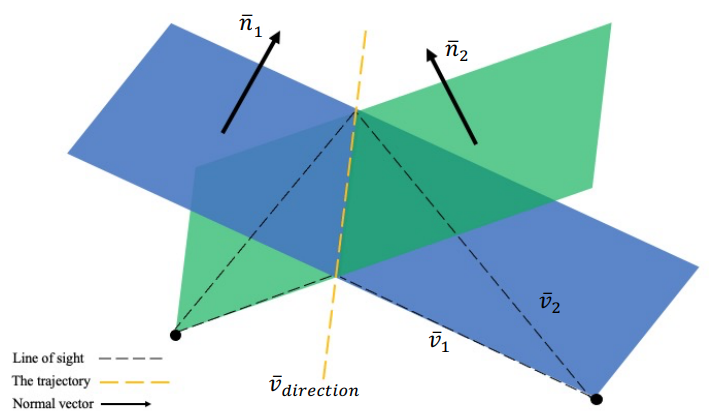
I'm afraid I also don't fully understand the meaning of the Pra/Pde parameters. The manual provides a brief description and even an illustration, but in such a projection the directions of the vectors are not entirely obvious. I have attached to this message what I think is a better drawing. Do I understand correctly that Pra/Pde are the Ra/Dec coordinates of the points to which vectors n1 and n2 are directed?
I would also like to clarify the meaning of the LD1/LD2 parameters: are they measured along the line of sight, looking directly at the meteor from the observation point, or is it the distance from the observation point to the projection of the meteor’s start/end points along the Earth’s surface?
I realize I may have asked a lot of questions, and I really hope I haven't burdened you too much. Thank you very much in advance!
| 説明: |
|
| ファイルサイズ: |
143.77 KB |
| 閲覧数: |
43354 回 |
|
|
|
| トップに戻る |
|
 |
SonotaCo
Site Admin
登録日: 2004.08.07
記事: 13650
所在地: 139.67E 35.65N
|
| 日時: Wed Nov 08, 2023 8:29 am 記事の件名: Re: Some questions about UFO Orbit 3.04 |
|
|
| Skymagic wrote: | | it is missing the 'az2' and 'ev2' fields and this appears to be a software bug. |
Please call it a design but a bug. There was no request for az2.ev2 so far. Possibly, they can be appendd in the future update.
| Skymagic wrote: | | OH, ZF, Er_sd, Voa and ZHR. |
Er_sd is the estimated standard deviation of the radiant direction by error propagation of observation error.
Other parameters are trials of new computatin methods, please ignore for now.
Voa is the trial for the cumputation of Vo at the start point.
OH,ZF,ZHR are the remains of a trial for easy computing of zenith hourly rate.
ZF = 1/sin(ev1r) and ZHR = ZF/hour_of_the_night
the sum of ZHR over same shower meteors on the night might close to historical zhr,
But this method was abandoned, because there is no way to consider the sky condition.
These are left just for the compatibility of the format.
| Skymagic wrote: | | Pra/Pde are the Ra/Dec coordinates of the points to which vectors n1 and n2 are directed? |
Yes they are. P meant Pole of the plane.
| Skymagic wrote: | | LD1/LD2 parameters: are they measured along the line of sight, looking directly at the meteor from the observation point, |
This is correct.
|
|
| トップに戻る |
|
|
Skymagic
登録日: 2016.07.26
記事: 27
|
| 日時: Wed Nov 08, 2023 8:41 pm 記事の件名: Re: Some questions about UFO Orbit 3.04 |
|
|
Dear SonotaCo,
Thank you very much for your prompt and informative response!
| SonotaCo wrote: | | There was no request for az2.ev2 so far. Possibly, they can be append in the future update. |
These options were described in the manual, but were missing from the U.csv. Actually, that’s why I decided that it could have been a mistake: I sincerely apologize for the hasty conclusion. Since I was the only one who raised such a question, perhaps you should not waste your time for me alone and devote it to more important things.
| SonotaCo wrote: | | Er_sd is the estimated standard deviation of the radiant direction by error propagation of observation error. Other parameters are trials of new computatin methods, please ignore for now. |
Thank you, now everything is clear. I noticed that sometimes the sd values look strange. I believe that functions for assessing the accuracy of calculations are EXTREMELY useful, especially when writing scientific papers. I sincerely hope that you will not give up on them in the future and will develop them. Surely this will be useful to many.
| SonotaCo wrote: | | the sum of ZHR over same shower meteors on the night might close to historical ZHR, But this method was abandoned, because there is no way to consider the sky condition. |
Thanks for the clarification. ZHR is a very important parameter, and it is a pity that it was not possible to fully implement it. I often had to resort to various tricks to calculate it, and I continue to encounter noticeable difficulties to this day. If you have time, could you share information about how it is calculated within your meteor network from video observations? If there is an article or topic on the forum (maybe in Japanese), please share the link. Thank you very much in advance!
|
|
| トップに戻る |
|
|
SonotaCo
Site Admin
登録日: 2004.08.07
記事: 13650
所在地: 139.67E 35.65N
|
|
| トップに戻る |
|
|
Skymagic
登録日: 2016.07.26
記事: 27
|
| 日時: Thu Nov 09, 2023 6:34 pm 記事の件名: Re: Some questions about UFO Orbit 3.04 |
|
|
Dear SonotaCo,
Once again thank you for your quick and helpful response! I have already read the publications you suggested and have largely clarified the situation for myself. Now I have no reason to be mistaken.
| SonotaCo wrote: | You are logical and polite. The question exchange with you is like talking with an AI.  |
Well, now I know what to devote my life to when man-made illumination finally deprives me of the opportunity to study meteors 
Jokes aside, you do a lot of work, but despite this, you are always ready to find the time and energy to help and give useful advice as quickly as possible. Logicality and politeness are the least I can do for you to make your work a little easier and to express my gratitude.
Thank you again for your help, and clear skies!
|
|
| トップに戻る |
|
|
Skymagic
登録日: 2016.07.26
記事: 27
|
| 日時: Tue Nov 28, 2023 9:48 pm 記事の件名: |
|
|
Hello SonotaCo,
with your permission, I would like to ask another question.
Last time you mentioned that the ZHR parameter is not calculated with UFO Orbit because it is difficult to take visibility conditions into account.
Nevertheless, this parameter is a very important characteristic of meteor activity, which is needed quite often.
If possible, can you please tell me if you calculate ZHR in your works? If yes, how exactly?
I tried to search for this information on the forum, but alas without success. I would be very grateful if you could reply. Thank you very much in advance!
|
|
| トップに戻る |
|
|
SonotaCo
Site Admin
登録日: 2004.08.07
記事: 13650
所在地: 139.67E 35.65N
|
| 日時: Wed Nov 29, 2023 7:28 am 記事の件名: |
|
|
| Skymagic wrote: |
If possible, can you please tell me if you calculate ZHR in your works? If yes, how exactly? |
ZHR could theoretically be calculated automatically if the stations involved were on a perfectly clear night.
However, the automatic calculation is likely to be misleading, since the weather makes the value meaningless.
Therefore, we prepared but did not experiment.
To realize this, I think it is necessary to measure the weather automatically or to establish a method to estimate the weather from the number of SPOs.
Since SonotaCo network has more than 15 years of accumulated observation results, I think it is now possible to create a method of estimating weather using the number of spo/hour, which is indexed by the smoothing of the ZHR curve for each meteor shower.
It means, now, we may be possible to obtain all meteor shower ZHR courves from the accumulated data, for the past and the future.
I think those who take up this challenge deserve the respect.
|
|
| トップに戻る |
|
|
Skymagic
登録日: 2016.07.26
記事: 27
|
| 日時: Wed Nov 29, 2023 6:00 pm 記事の件名: |
|
|
Dear SonotaCo,
as before, I am very grateful for your quick reply and interesting thought. If I am not mistaken, in big astronomy the limiting magnitude of the stars present in the frame is used to determine the observing conditions. Since UFO Analyzer always knows which stars are in the frame, it probably makes sense to define seeing conditions as the ratio of the number of visible stars to the total number of stars in the catalog. In essence, this is very similar to your idea of estimating sporadic meteor backgrounds, but stars can be used as a tool. You could also try to measure the observed stellar magnitude of bright stars and compare it to the catalog: the decrease in brightness will depend on atmospheric transparency.
In addition, the comparison can be made not with the catalog, but with some reference video frame. Obviously, this approach will require additional calibration, but it can be done at the stage of creating a processing profile using a frame with known favorable observing conditions.
I would also like to offer you an article that I discovered just today. Apparently, the authors have achieved success with automatic ZHR determination (see pages 9-10). You may find it useful.
| 説明: |
|

ダウンロード |
| ファイル名: |
GMN Computing optical meteor.pdf |
| ファイルサイズ: |
7.04 MB |
| ダウンロード回数: |
1088 回 |
|
|
| トップに戻る |
|
|
|
|
新規投稿: 不可
返信投稿: 不可
記事編集: 不可
記事削除: 不可
投票参加: 不可
このフォーラムで添付ファイルを投稿 できません
このフォーラムでファイルをダウンロード できます
|
Powered by phpBB © 2001, 2005 phpBB Group
|
 Top Page
 FAQ
FAQ 検索
検索 メンバーリスト
 ユーザーグループ
 登録する
登録する プロフィール
 プライベートメッセージをチェックする
 ログイン
ログイン

